Showing posts with label Borg. Show all posts
Showing posts with label Borg. Show all posts
2014-02-25


2013-12-28

2013-12-19
Busy, busy, some new toys
Sony A7. Very nice! Peaking is especially well implemented. I plan on using this with old lenses, and maybe for some astrophotography, while keeping my EM-1 as my main camera. I got Nikon and OM adapters for use with my existing lenses, but will try out some more old glass.
Borg 67FL. Wow! With the 0.66x DGT reducer (now discontinued), this goes all the way down to 198mm and f/2.95! It also works with the 0.7x multi-reducer (7870), though it's only recommended for an APS-sized field, not the full 35mm field. The 0.85 reducer (7885) can also be used. A flattener for these shorter focal lengths will be coming along. No clear skies since I bought this.
I expect the T-ratio to be better than the Nikon 180/2.8ED Ai-S. I'll probably sell both the Nikon and my Borg 60ED.
Starlight Xpress 2" filter wheel. This is nicely made, and good value. The slightly taller than necessary Baader 2" filters fit without any problems.
Various adapters to hook up my QHY-8 and ST-8300M directly, with or without the filterwheel, via threaded parts rather than going through an EOS bayonet mount. This should help reduce sag. Yay, more adapters....
Pre-ordered the Vixen 100/3.8 VSD. I expect delivery in early February next year.
Bye-bye to my Mamiya-6 RF kit. Great camera, great glass, but I just wasn't using it.
2013-11-19

2010-08-08
Borg 71FL is pretty damn good
Here is a post with a photo that shows some Fresnel rings. I need to do a proper Roddier test, but it's looking pretty good.
2010-07-29

2010-07-19
Borg 77EDII
Note
I originally wrote this post back in November 2009, and it has languished as a draft. Since then, I've added the 135mm tube (7135) that allows use of the f/4 ED reducer and the new 0.78DGT triplet reducer (7878).
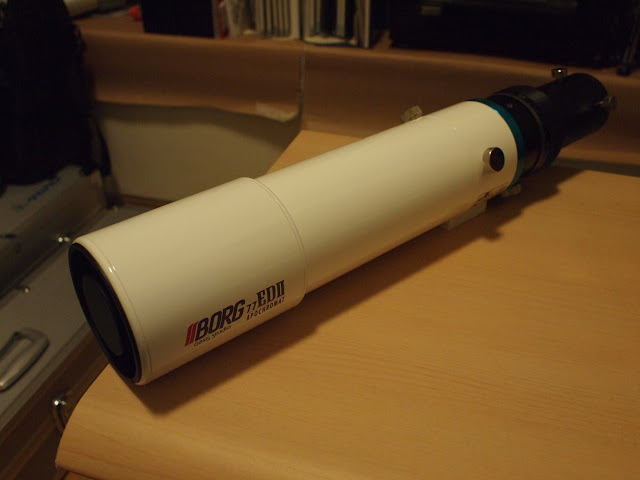
My new Borg 77EDII (available from Hutech outside of Japan) arrived today from Starbase.

The 77EDII package (6000 and 2178) comes with a drawtube, helical focusser, two M57 extension tubes (7509, 7508) that also allow use of 2" accessories, and a T-ring adapter (7522). The tube has a clever flat mount area that can be used to attach the scope to a tripod, or to attach a finder mount or other accessories.

Both the tube and the lens assembly come with caps for use when the scope is broken down for transport. Nice. I would've liked these for my 125SD - there is not even the option to buy them separately. The lens cell doesn't appear to be adjustable, but looks like it will accept 77mm filters (note it doesn't, you can use 82mm filters if you take the nameplate off, see here). The lens hood is retractable, but doesn't slide into place with a satisfying click, as the Pentax 75SDHF does, or have a screw to hold it in place, like the Tak Sky-90 and FSQ-85ED. However, the hood is small and light, so I don't think it being held in place by friction will be a problem.

In addition I bought the 80mm rings (7080), the plastic clamshell (5503) and a Vixen-style finder mount (7755n). I also added one accessory that currently seems to be available only in Japan, the Yuetsu-27g base ring from Scopelife. This is the well-machined (カワセミ or "Kingfisher") blue ring in the photos. This provides a tighter fit around the extensible draw tube and reduces sag. I became aware of this accessory through the Borg "topics" blog (Japanese). Note the blog is now at http://www.tomytec.co.jp/borg/world/blog/.

The flexibility and value for money of Borg scopes and accessories seems to increase the more you buy. I can use the M57 FeatherTouch focusser and MDX "helicoid" with ED F4DG reducer for my 125SD on the 77EDII with no problem. I think I can also use the 0.85x DG (7885) and 0.66x DGT (7866) reducers for the mini-Borg series that I have for use with my 60ED. Both of these reducers are usable up to 500mm focal length, only cover an APS-C sized sensor, but have the advantage of being tiny.
Compare this to my Taks. I have a 35mm reducer, (separate) 35mm flattener and 1.6x extender specific to the TOA-130/150, the 0.73 reducer ED and 1.5 extender ED for the FSQ-ED and Sky-90 reducer and Extender-Q for the Sky-90 and FSQ. To be fair, the extenders can all be used with other scopes - I think. And with some ingenuity some of the reducers can be used on other scopes, but not easily.
With the F4DG reducer, the focal length of the 77EDII is around 330mm at f/4.3. On a 35mm full frame this is just over 6 by 4 degrees, with a 7.5 degree diagonal. This should provide nice wide-field images. For H-alpha, the Olympus 250/2 and 250/2.8 have the advantage of speed, though at the cost of weight. The Pentax 645 300/4 provides a comparable FOV at a comparable weight, but the Borg's flexibility would have it win for a trip. Anyway, it will be fun to try them out and compare.
I missed out on the Borg 0.85x DGL reducer/ (7887) for 35mm full-frame, so will wait and pick up the 0.78x triplet reducer when it becomes available. I recently managed to find the fairly rare 35mm 1.04x flattener (7784) on Yahoo Auction in Japan, which I will pick up over the New Year holiday. This set of reducers/flatteners will give 330, 395 and 530mm focal lengths on a full 35mm frame. Surely in terms of flexibility, this has to be one of the best small portable photo-visual refractors available?
The 77EDII is pretty large compared to the 60ED when assembled.
I originally wrote this post back in November 2009, and it has languished as a draft. Since then, I've added the 135mm tube (7135) that allows use of the f/4 ED reducer and the new 0.78DGT triplet reducer (7878).
My new Borg 77EDII (available from Hutech outside of Japan) arrived today from Starbase.

The 77EDII package (6000 and 2178) comes with a drawtube, helical focusser, two M57 extension tubes (7509, 7508) that also allow use of 2" accessories, and a T-ring adapter (7522). The tube has a clever flat mount area that can be used to attach the scope to a tripod, or to attach a finder mount or other accessories.

Both the tube and the lens assembly come with caps for use when the scope is broken down for transport. Nice. I would've liked these for my 125SD - there is not even the option to buy them separately. The lens cell doesn't appear to be adjustable, but looks like it will accept 77mm filters (note it doesn't, you can use 82mm filters if you take the nameplate off, see here). The lens hood is retractable, but doesn't slide into place with a satisfying click, as the Pentax 75SDHF does, or have a screw to hold it in place, like the Tak Sky-90 and FSQ-85ED. However, the hood is small and light, so I don't think it being held in place by friction will be a problem.

In addition I bought the 80mm rings (7080), the plastic clamshell (5503) and a Vixen-style finder mount (7755n). I also added one accessory that currently seems to be available only in Japan, the Yuetsu-27g base ring from Scopelife. This is the well-machined (カワセミ or "Kingfisher") blue ring in the photos. This provides a tighter fit around the extensible draw tube and reduces sag. I became aware of this accessory through the Borg "topics" blog (Japanese). Note the blog is now at http://www.tomytec.co.jp/borg/world/blog/.

The flexibility and value for money of Borg scopes and accessories seems to increase the more you buy. I can use the M57 FeatherTouch focusser and MDX "helicoid" with ED F4DG reducer for my 125SD on the 77EDII with no problem. I think I can also use the 0.85x DG (7885) and 0.66x DGT (7866) reducers for the mini-Borg series that I have for use with my 60ED. Both of these reducers are usable up to 500mm focal length, only cover an APS-C sized sensor, but have the advantage of being tiny.

Compare this to my Taks. I have a 35mm reducer, (separate) 35mm flattener and 1.6x extender specific to the TOA-130/150, the 0.73 reducer ED and 1.5 extender ED for the FSQ-ED and Sky-90 reducer and Extender-Q for the Sky-90 and FSQ. To be fair, the extenders can all be used with other scopes - I think. And with some ingenuity some of the reducers can be used on other scopes, but not easily.
With the F4DG reducer, the focal length of the 77EDII is around 330mm at f/4.3. On a 35mm full frame this is just over 6 by 4 degrees, with a 7.5 degree diagonal. This should provide nice wide-field images. For H-alpha, the Olympus 250/2 and 250/2.8 have the advantage of speed, though at the cost of weight. The Pentax 645 300/4 provides a comparable FOV at a comparable weight, but the Borg's flexibility would have it win for a trip. Anyway, it will be fun to try them out and compare.
I missed out on the Borg 0.85x DGL reducer/ (7887) for 35mm full-frame, so will wait and pick up the 0.78x triplet reducer when it becomes available. I recently managed to find the fairly rare 35mm 1.04x flattener (7784) on Yahoo Auction in Japan, which I will pick up over the New Year holiday. This set of reducers/flatteners will give 330, 395 and 530mm focal lengths on a full 35mm frame. Surely in terms of flexibility, this has to be one of the best small portable photo-visual refractors available?
The 77EDII is pretty large compared to the 60ED when assembled.
Borg 2010X2 is a 71mm fluorite
The new Borg 71 FL is out. It can be used with the mini-Borg tubes/accessories as well as the 80mm diameter tubes. The first batch of 100 has nearly sold out already. I lasted all of two days without ordering one.
It's 400mm f/5.6. With the 0.66 DGT reducer, this will be 264mm @ f3.72, roughly 4.8 by 3.2 degrees on an APS-C sensor. With the 0.85 DG reducer, 340mm @ f/4.69, which is 3.7 by 2.5 degrees.
It's 400mm f/5.6. With the 0.66 DGT reducer, this will be 264mm @ f3.72, roughly 4.8 by 3.2 degrees on an APS-C sensor. With the 0.85 DG reducer, 340mm @ f/4.69, which is 3.7 by 2.5 degrees.
2010-01-27
Some notes on viewing Mars with different scopes
Having gotten fed up with the number of failed imaging attempts recently, and with Mars being near opposition, I've been having "quick peeks" with some of my scopes, and using some of my heavier scopes for observing Mars.
Recently I've viewed Mars with:
I generally used Pentax XW eyepieces, though I also tried a 5mm ortho, which may have been slightly better than the XW-5. I used a Tak 2" diagonal. On both the C8 and C11, I use a Borg helical focuser for fine focusing. This helps a lot. Comparisons were done at magnifications as similar as possible. I also tried to find the best magnification for the scope and conditions.
The C8 on an alt-az mount is a nice "grab'n'go" scope. As I currently live in Singapore, there is virtually no time needed for cool-down, or rather, warm-up, and temperatures stay very constant throughout the night. I no longer have to worry about those annoying tube currents. Also, the planets and Moon reach high in the sky here, so the C8's sensitivity to seeing is lessened. Overall Singapore is a good place to own an SCT or other compound scope. You will want the aperture to help with the light pollution.
The C8 shows an annoyingly large bright halo around Mars, and contrast could be better. The edges of the planet are a little soft, and the colour is a very washed out orange-ish pink. Detail is good with the planet near the centre of the FOV, but drops off quickly towards the edges. I compared the Borg 125SD on the same night. At higher magnifications, lateral colour shows up off-centre and is quite intrusive. There is no annoying halo, and the planet shows good detail, nice contrast and the disk has has nice crisp edges. The 125SD snaps to focus well. Overall I'd say I'd prefer the C8 on an alt-az mount. I previously tested the C8 versus the 125SD on Jupiter when I lived in Tokyo, and the 125SD was sightly better, mainly due to contrast - but this was on my EM-200, so the planet was kept dead centre, and I was viewing a shadow transition, where contrast is probably more important. I don't recall colour being an issue with the 125SD and there is nothing about it in my notes. Worth noting is that the 125SD is the only scope I used an extender with - the Tak TOA 1.6 extender, and this was the first time I used this. I intend to try out other extenders to see if there's any difference - I doubt it.
On another night, I compared the TOA130F and the C11. This was my first light of the C11 after I took it apart to re-grease the baffle tube, add flocking to the inside of the tube and clean the primary. I was able to collimate quickly and easily and had nice symmetrical diffraction rings around a roughly mag 7 star. The C11 provides an image that is too bright at "lower" magnifications. At over 400x the contrast and view overall was better - the seeing probably limited resolution to less than these magnifications, but the dimmer image was easier on the eye. The C11 still has the halo that the C8 has, but it was less intrusive - maybe the flocking is helping here? I will add flocking to the C8 to see if it helps. Off-axis performance wasn't an issue as I was using the EM-200. Overall I enjoyed the views through the C11, they have the same "quality" or "feel" as the C8, just more so. The light-gathering power means you have a larger exit pupil, so it's quite comfortable to sit at the eyepiece. I did have to faff around with focussing a bit, however, and the edges of the planet were still a little soft.
The TOA130F is simply an amazing scope. There is no false colour, image contrast and sharpness is incredible. Mars snapped to focus and I didn't have to play around with anything, just sit there and enjoy the view. The disc has razor-sharp edges, great contrast and great detail. I used the TOA before the C11 when Mars was lower in the sky, probably around 50 degrees, and the C11 later when Mars was higher - over 70 degrees. The C11 did show more detail in the few seconds of great seeing that came and went, but I was surprised how poor the contrast was compared to the TOA. Also, I felt I had to try harder to see the same detail in the C11 at equivalent powers. For visual viewing, I preferred the TOA overall, which surprised me - I expected the C11 to be better. The C11 is definitely a very nice planetary scope. The fact that the TOA, with less than half the aperture is so close to the performance of the C11 just goes to show how great this scope is. I didn't compare the TOA to the C8 on the same night, but from memory, the TOA is far, far better than the C8.
Seeing was not good the night I tried out the FCT-125, it was earlier in the evening, so Mars was low and I didn't compare it against any other scopes that night. The FCT-125 has amazing control of colour for such a fast refractor. The disc of Mars was sharply defined and contrast good - the polar cap was obvious and in moments of good seeing, detail could be made out in the cap. The bad seeing prevented much detail on the surface being seen. From memory the image in the TOA130F was brighter. For a f/5.6 refractor aimed at imaging (the MF reducer brings the scope to 4.5 with a wide corrected field), this scope did very well on Mars. I'd like to test it again versus the C8 and TOA.
Overall, from these limited, poorly executed, subjective tests, I'd rank the scopes as follwing:
The Borg 125SD is an f/6 doublet, so the lateral colour is no surprise. Despite this it was close to the C8's performance and had better contrast. I expect that if I do the comparison again on a GEM, the 125SD might be better overall. The 125SD is a great imaging scope when combined with the f/4 ED reducer - very wide, well corrected, flat and colour-free. It's a great all-round scope, incredibly light, very flexible due to the Borg system and has a "fun factor" that some scopes lack.
The C8 confirmed its reputation as a good planetary scope in a tiny lightweight package given good conditions and proper collimation. In my environment, it actually works quite well as a "quick peek" scope. The difference between the C8 and the TOA was not at all subtle. The TOA was far, far better. Seeing was too poor, and I didn't compare the FCT-125 versus another scope on the same night, so I'm less sure, but overall it did seem to outperform the C8, certainly there was more contrast, a sharper disk edge and less faffing around with focussing - despite it being f/5.6 and lacking a slow-motion focuser.
On the night I tested the C11 and TOA, I sometimes used a Baader Neodymium filter. This helps improve contrast on Mars. Stacking this with the Baader "fringe killer" improves contrast again, though only slightly. I also tried out a Mizar "mu" filter (Nebula filter) for a laugh, and was surprised that it actually improved contrast quite a bit!
Ironically, the good performance of the C8 has led to me wanting a Tak Mewlon 210 even more. So, I may sell the C8 and C11.
I stress that this was visual observing, where contrast and seeing are important. For planetary imaging, resolution and a bright image to get good SNR at larger image scales are important, and the C11 should easily be the best here. Stacking the good frames effectively allows you to tune seeing versus SNR.
As an aside, I recently purchased the Celestron Vibration Suppression Pads. I was dubious at first, but they really work well. I strongly recommend these.
Recently I've viewed Mars with:
- Takahashi FCT-125 on Vixen SXW
- Takahashi TOA130F on EM-200
- Celestron C8 on TGL alt-az
- Borg 125SD on TGL alt-az
- Celestron C11 on EM-200
I generally used Pentax XW eyepieces, though I also tried a 5mm ortho, which may have been slightly better than the XW-5. I used a Tak 2" diagonal. On both the C8 and C11, I use a Borg helical focuser for fine focusing. This helps a lot. Comparisons were done at magnifications as similar as possible. I also tried to find the best magnification for the scope and conditions.
The C8 on an alt-az mount is a nice "grab'n'go" scope. As I currently live in Singapore, there is virtually no time needed for cool-down, or rather, warm-up, and temperatures stay very constant throughout the night. I no longer have to worry about those annoying tube currents. Also, the planets and Moon reach high in the sky here, so the C8's sensitivity to seeing is lessened. Overall Singapore is a good place to own an SCT or other compound scope. You will want the aperture to help with the light pollution.
The C8 shows an annoyingly large bright halo around Mars, and contrast could be better. The edges of the planet are a little soft, and the colour is a very washed out orange-ish pink. Detail is good with the planet near the centre of the FOV, but drops off quickly towards the edges. I compared the Borg 125SD on the same night. At higher magnifications, lateral colour shows up off-centre and is quite intrusive. There is no annoying halo, and the planet shows good detail, nice contrast and the disk has has nice crisp edges. The 125SD snaps to focus well. Overall I'd say I'd prefer the C8 on an alt-az mount. I previously tested the C8 versus the 125SD on Jupiter when I lived in Tokyo, and the 125SD was sightly better, mainly due to contrast - but this was on my EM-200, so the planet was kept dead centre, and I was viewing a shadow transition, where contrast is probably more important. I don't recall colour being an issue with the 125SD and there is nothing about it in my notes. Worth noting is that the 125SD is the only scope I used an extender with - the Tak TOA 1.6 extender, and this was the first time I used this. I intend to try out other extenders to see if there's any difference - I doubt it.
On another night, I compared the TOA130F and the C11. This was my first light of the C11 after I took it apart to re-grease the baffle tube, add flocking to the inside of the tube and clean the primary. I was able to collimate quickly and easily and had nice symmetrical diffraction rings around a roughly mag 7 star. The C11 provides an image that is too bright at "lower" magnifications. At over 400x the contrast and view overall was better - the seeing probably limited resolution to less than these magnifications, but the dimmer image was easier on the eye. The C11 still has the halo that the C8 has, but it was less intrusive - maybe the flocking is helping here? I will add flocking to the C8 to see if it helps. Off-axis performance wasn't an issue as I was using the EM-200. Overall I enjoyed the views through the C11, they have the same "quality" or "feel" as the C8, just more so. The light-gathering power means you have a larger exit pupil, so it's quite comfortable to sit at the eyepiece. I did have to faff around with focussing a bit, however, and the edges of the planet were still a little soft.
The TOA130F is simply an amazing scope. There is no false colour, image contrast and sharpness is incredible. Mars snapped to focus and I didn't have to play around with anything, just sit there and enjoy the view. The disc has razor-sharp edges, great contrast and great detail. I used the TOA before the C11 when Mars was lower in the sky, probably around 50 degrees, and the C11 later when Mars was higher - over 70 degrees. The C11 did show more detail in the few seconds of great seeing that came and went, but I was surprised how poor the contrast was compared to the TOA. Also, I felt I had to try harder to see the same detail in the C11 at equivalent powers. For visual viewing, I preferred the TOA overall, which surprised me - I expected the C11 to be better. The C11 is definitely a very nice planetary scope. The fact that the TOA, with less than half the aperture is so close to the performance of the C11 just goes to show how great this scope is. I didn't compare the TOA to the C8 on the same night, but from memory, the TOA is far, far better than the C8.
Seeing was not good the night I tried out the FCT-125, it was earlier in the evening, so Mars was low and I didn't compare it against any other scopes that night. The FCT-125 has amazing control of colour for such a fast refractor. The disc of Mars was sharply defined and contrast good - the polar cap was obvious and in moments of good seeing, detail could be made out in the cap. The bad seeing prevented much detail on the surface being seen. From memory the image in the TOA130F was brighter. For a f/5.6 refractor aimed at imaging (the MF reducer brings the scope to 4.5 with a wide corrected field), this scope did very well on Mars. I'd like to test it again versus the C8 and TOA.
Overall, from these limited, poorly executed, subjective tests, I'd rank the scopes as follwing:
- TOA130F
- Celestron C11
- FCT-125
- C8
- Borg 125SD
The Borg 125SD is an f/6 doublet, so the lateral colour is no surprise. Despite this it was close to the C8's performance and had better contrast. I expect that if I do the comparison again on a GEM, the 125SD might be better overall. The 125SD is a great imaging scope when combined with the f/4 ED reducer - very wide, well corrected, flat and colour-free. It's a great all-round scope, incredibly light, very flexible due to the Borg system and has a "fun factor" that some scopes lack.
The C8 confirmed its reputation as a good planetary scope in a tiny lightweight package given good conditions and proper collimation. In my environment, it actually works quite well as a "quick peek" scope. The difference between the C8 and the TOA was not at all subtle. The TOA was far, far better. Seeing was too poor, and I didn't compare the FCT-125 versus another scope on the same night, so I'm less sure, but overall it did seem to outperform the C8, certainly there was more contrast, a sharper disk edge and less faffing around with focussing - despite it being f/5.6 and lacking a slow-motion focuser.
On the night I tested the C11 and TOA, I sometimes used a Baader Neodymium filter. This helps improve contrast on Mars. Stacking this with the Baader "fringe killer" improves contrast again, though only slightly. I also tried out a Mizar "mu" filter (Nebula filter) for a laugh, and was surprised that it actually improved contrast quite a bit!
Ironically, the good performance of the C8 has led to me wanting a Tak Mewlon 210 even more. So, I may sell the C8 and C11.
I stress that this was visual observing, where contrast and seeing are important. For planetary imaging, resolution and a bright image to get good SNR at larger image scales are important, and the C11 should easily be the best here. Stacking the good frames effectively allows you to tune seeing versus SNR.
As an aside, I recently purchased the Celestron Vibration Suppression Pads. I was dubious at first, but they really work well. I strongly recommend these.
Subscribe to:
Posts (Atom)